


Page 310 - ISC PROCEEDINGS 21.4
P. 310
This perspective aligns with the argument that “code functions as law” in digital
                  environments (Lessig, 2006), where technical design can shape user behavior without
                  direct legal enforcement. Technical constraints embedded within DRM systems are
                  capable of shaping user behavior without requiring direct intervention by state regulatory
                  authorities.
                        The relationship between DRM and the “walled garden” model is inherently
                  complementary. While the walled garden represents the structural organization of the
                  market, DRM serves as the technical instrument that operationalizes this structure.
                  Through DRM, firms can control the compatibility between devices, software, and
                  content; restrict the transfer of content to competing platforms; develop proprietary
                  technological standards to reinforce ecosystem positioning; and create technical barriers
                  to entry for potential competitors.
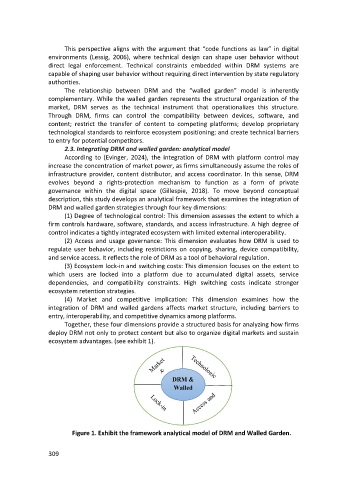
                        2.3. Integrating DRM and walled garden: analytical model
                        According to (Evinger, 2024), the integration of DRM with platform control may
                  increase the concentration of market power, as firms simultaneously assume the roles of
                  infrastructure provider, content distributor, and access coordinator. In this sense, DRM
                  evolves beyond a rights-protection mechanism to function as a form of private
                  governance within the digital space (Gillespie, 2018). To move beyond conceptual
                  description, this study develops an analytical framework that examines the integration of
                  DRM and walled garden strategies through four key dimensions:
                        (1) Degree of technological control: This dimension assesses the extent to which a
                  firm controls hardware, software, standards, and access infrastructure. A high degree of
                  control indicates a tightly integrated ecosystem with limited external interoperability.
                        (2) Access and usage governance: This dimension evaluates how DRM is used to
                  regulate user behavior, including restrictions on copying, sharing, device compatibility,
                  and service access. It reflects the role of DRM as a tool of behavioral regulation.
                        (3) Ecosystem lock-in and switching costs: This dimension focuses on the extent to
                  which users are locked into a platform due to accumulated digital assets, service
                  dependencies, and compatibility constraints. High switching costs indicate stronger
                  ecosystem retention strategies.
                        (4) Market and competitive implication: This dimension examines how the
                  integration of DRM and walled gardens affects market structure, including barriers to
                  entry, interoperability, and competitive dynamics among platforms.
                        Together, these four dimensions provide a structured basis for analyzing how firms
                  deploy DRM not only to protect content but also to organize digital markets and sustain
                  ecosystem advantages. (see exhibit 1).


                          Figure 1. Exhibit the framework analytical model of DRM and Walled Garden.


                  309

